PM & PO – Hunting the Third Diamond: From Delivering Outputs to Creating Real Value
AI is accelerating software development, prototyping, and design so dramatically that an increasingly important question is whether we are building the right things in the first place.
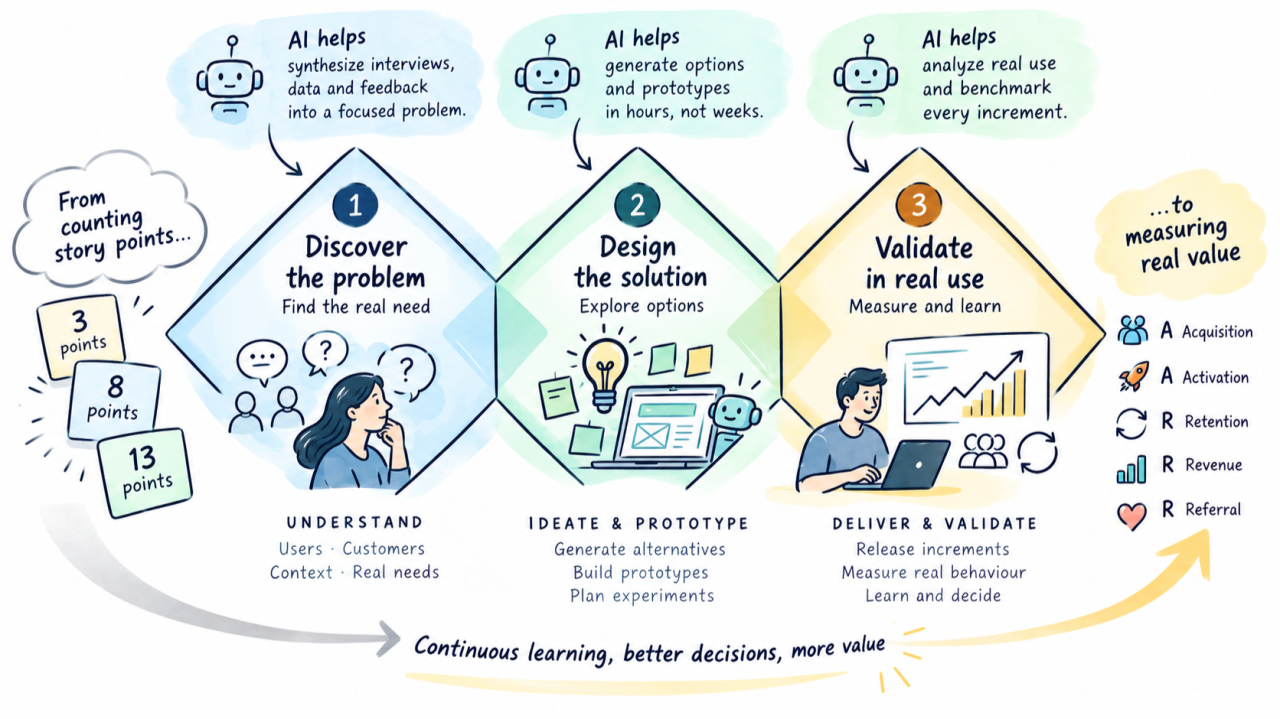
One of the most significant future trends in product development is the shift from measuring delivery efficiency to measuring the value created. Artificial intelligence is accelerating software development, prototyping, and design so dramatically that an increasingly important question is whether we are building the right things in the first place. As developing alternative solutions becomes faster and less expensive, organizations' competitiveness will increasingly depend on their ability to experiment, learn, and identify which solutions truly create customer and business value.
This article is based on my presentation PM & PO – Hunting the Third Diamond: From Counting Story Points to Measuring Real Value in the Age of AI, delivered at Projektipäivät on October 20, 2026.
As Delivery Accelerates, Making the Right Decisions Becomes More Important
For many Product Managers and Product Owners, daily work still revolves around prioritizing backlogs, estimating story points, creating roadmaps, and tracking development progress. Agile development has taught us to measure workflow, lead times, and predictability. These are important metrics, but they do not tell us whether the work being done actually creates value for customers.
AI challenges this way of thinking even further. When AI can write user stories, generate code, build prototypes, and analyze feedback, the number of features delivered becomes less meaningful as a measure of success. As implementation costs decrease, the scarce resource becomes the ability to determine what is worth building, what to experiment with next, and when to stop development.
This also changes the nature of product leadership. The primary responsibility of a Product Manager or Product Owner is no longer to ensure that the organization completes as much work as possible, but rather to ensure that it learns as quickly as possible which things are worth doing.
From the Double Diamond to the Third Diamond
The well-known Double Diamond model by the UK Design Council describes the innovation process through two diamonds. The first diamond focuses on exploring the problem space and understanding the customer's real needs. The second diamond involves exploring alternative solutions and selecting the most promising ones.
Design sprints, UX design, and continuous discovery have helped organizations develop these capabilities. AI significantly accelerates both stages. Analyzing user interviews, generating alternative solutions, and building prototypes can now take a fraction of the time previously required. In some situations, an experimentation cycle that traditionally required a five-day Design Sprint can be completed in as little as two days.
But what happens after a solution has been selected?
This is where the Third Diamond comes in. Its purpose is to ensure that development outcomes actually deliver value in real-world use. In the Third Diamond, implementation and validation happen in parallel. Every new increment provides an opportunity to measure impact, compare results with expectations, and decide whether the chosen solution is worth developing further.
Delivery is therefore not the end of learning, but the beginning of a new learning cycle.
Experimentation Becomes a Core Practice in Product Development
As AI reduces the cost of experimentation, organizations can explore multiple solution alternatives simultaneously. However, this does not automatically lead to better products. If the objectives and success criteria of experiments are not defined in advance, the result may simply be a large number of rapidly developed solutions with no real evidence of their value.
Strategyzer's Test Cards offer a simple way to introduce discipline into experimentation. Before starting an experiment, we define what we believe, how we will test that assumption, and what results would validate it. This turns experimentation into an intentional learning process rather than just another way of producing features.
AI can help generate alternatives, design experiments, and analyze results, but it cannot replace genuine customer feedback. An AI-generated prediction that customers will like a new solution is not the same as evidence gathered from real customers.
Measuring Value Requires New Metrics
Story points and velocity describe the work of a development team, but they do not measure the customer value created. Flow metrics, such as lead time and work in progress, indicate the efficiency of the development process. To understand real value, we need metrics that reflect customer behavior and the business impact of a product.
One useful framework for measuring the value of digital products is the AARRR model, also known as Pirate Metrics. It examines the customer journey from discovering a product to using it, continuing to use it, generating business value, and recommending it to others.
One particularly interesting metric is retention. If a product continuously delivers value, customers return to use it. If it fails to create value, usage declines over time. For this reason, cohort-based retention analysis may reveal more about a product's success than traditional customer satisfaction surveys.
However, when selecting metrics, it is essential to understand what changes in behavior we want to achieve. Gojko Adzic's Impact Mapping offers a useful approach: first define the business objective, then identify the actors and the desired behavioral changes, and only then determine which features are needed.
If a feature in the development backlog cannot be linked to a desired impact, it is worth asking why it is being built.
The Roles of Product Managers and Product Owners Are Changing
The Third Diamond approach also transforms roles in product development. The Product Manager is responsible for identifying the most valuable opportunities and making decisions about where the organization should invest. The Product Owner, in turn, helps translate these decisions into learning and tangible deliveries as quickly as possible.
The role of UX design is to ensure that solutions address real user needs, while architecture must enable fast and safe experimentation. Value is not created by any single role but through collaboration between these capabilities.
With AI, the importance of collaboration becomes even greater. As design, prototyping, and implementation accelerate, traditional handoffs between roles can become bottlenecks in development. For example, in MobAI®, specialists from different disciplines develop solutions together with AI, allowing clarifications, design choices, and decisions to be made within the same workflow.
At the same time, the focus of planning is changing. AI can prepare plans, analyze dependencies, and help evaluate alternatives, but people remain responsible for aligning objectives, making decisions, and committing to shared outcomes.
Hunting the Third Diamond Means Continuous Decision-Making
Future product and portfolio management will increasingly emphasize the ability to direct investments based on insights gained from experimentation. Instead of committing to a predefined list of features over a long period, organizations will define the outcomes they want to achieve and empower teams to discover the best ways to achieve them.
The OKR approach supports this shift. The Product Manager defines the objective and measurable key results, while teams design experiments to achieve those results. Development success is evaluated not only by the features delivered but by whether the desired outcomes have been achieved.
At every major decision point, we should be able to answer three questions: What did we expect to happen? What did customers actually do? What did we learn?
Based on these insights, we decide whether to continue development, change direction, scale the solution, or stop the work entirely.
This also requires a new kind of leadership culture. Ending an experiment should not be seen as a failure if it provides reliable evidence that a solution does not deliver the expected value. On the contrary, making the decision to stop early can save significant investments and free up capacity for more valuable opportunities.
In the Age of AI, What Matters Most Is Not How Much We Produce
Artificial intelligence makes it possible to build more solutions in less time. This makes product development faster, but not automatically more effective. If organizations continue to measure success primarily by the volume of outputs, AI may simply accelerate the development of the wrong things.
The Third Diamond approach offers an alternative. Product development becomes a continuous process of discovering, experimenting with, and validating value. The most important shared responsibility of the Product Manager and Product Owner is to ensure that the organization learns from its investments and can change direction based on new insights.
Ultimately, hunting the Third Diamond is not about finding the right solution on the first attempt. It is about an organization's ability to identify, as quickly as possible, which solutions create value and which do not.
When AI makes experimentation inexpensive, the courage to stop pursuing the wrong solution becomes more valuable than ever.
References
- UK Design Council, Double Diamond
https://www.designcouncil.org.uk/resources/the-double-diamond/ - The Triple Diamond Design Process: A Comprehensive Guide
https://www.launchnotes.com/blog/the-triple-diamond-design-process-a-comprehensive-guide - Strategyzer, Test Card
https://www.strategyzer.com/library/validate-your-ideas-with-the-test-card - Raj, AARRR, or "Pirate Metrics", Medium
https://medium.com/design-bootcamp/aarrr-or-pirate-metrics-5110836367bf - Gojko Adzic, Impact Mapping
https://gojko.net/books/impact-mapping/ - MobAI®
https://www.wikiagile.com/fi/mobai - OKRs
https://www.whatmatters.com/