Product Development in the AI Era: Building for Adaptability
Artificial intelligence is changing product development. But for hardware companies, the transformation is about much more than adding AI tools to existing engineering processes.
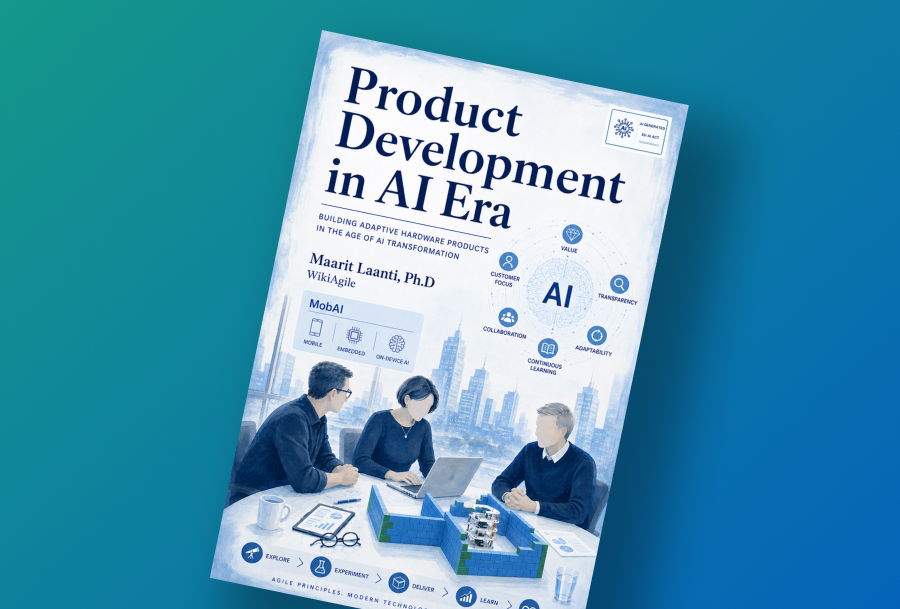
Three forces are converging at the same time: artificial intelligence, agile hardware development, and growing regulatory and sustainability requirements. Together, they are changing how products are designed, developed, and evolved.
These changes are at the heart of Maarit Laanti’s new book, Product Development in AI Era – Building Adaptive Hardware Products in the Age of AI Transformation.
AI makes speed possible — but architecture makes it useful
AI can already support engineering teams by running simulations, generating test scenarios, and accelerating documentation.
But making individual activities faster does not necessarily make the whole product development process faster.
If products are tightly coupled and changes require coordination across multiple teams and components, the bottleneck simply moves somewhere else.
This is why architecture becomes strategy.
A modular architecture with clean, stable interfaces allows teams to change one part of a product without creating a ripple of changes throughout the entire system. Teams can work more independently, and different parts of the product can evolve at different speeds.
Modularity is a deliberate choice
Modularity does not mean making everything independent.
Instead, organizations need to decide deliberately what should be coupled and what should be free to evolve independently.
The book uses Tesla as an example: a car seat and its software can evolve together as a vertical slice, while other parts of the vehicle may function as stable platforms or separable modules. The same product can therefore be tightly coupled in one area and modular in another — by design.
This becomes increasingly important as AI accelerates experimentation and engineering. Product architectures and organizations need to be able to absorb that speed.
From faster development to faster learning
Ultimately, the opportunity is not simply to use AI to do the same work faster.
It is to create product development systems that can learn and adapt faster.
Shorter iterations, modular architectures, independent teams, and AI-supported engineering can reduce the distance between an idea, a working solution, and what we learn from it.
That ability to continuously learn and adapt may become one of the defining capabilities of successful hardware organizations in the AI era.
Explore Product Development in AI Era
These ideas are explored further in Maarit Laanti’s Product Development in AI Era. Part 1 covers AI-driven product development, architecture and modularity, sustainable business models, and validated learning.
Part 1 is available as a free preview on Leanpub, with future parts added as they are released.
“Maarit Laanti has written the perfect, clear, referenced and complete roadmap that will save legacy companies. Make this book your management, executive, or board member book-club weekly read.”
Joe Justice
Microsoft, Amazon, Wikispeed, Tesla, ABI — from the Foreword
→ Download Part 1 of Product Development in AI Era